
Business
Company Incorporation Stamp Duty Calculator
Check stamp duty in your State and incorporate hassle-free.
Calculate
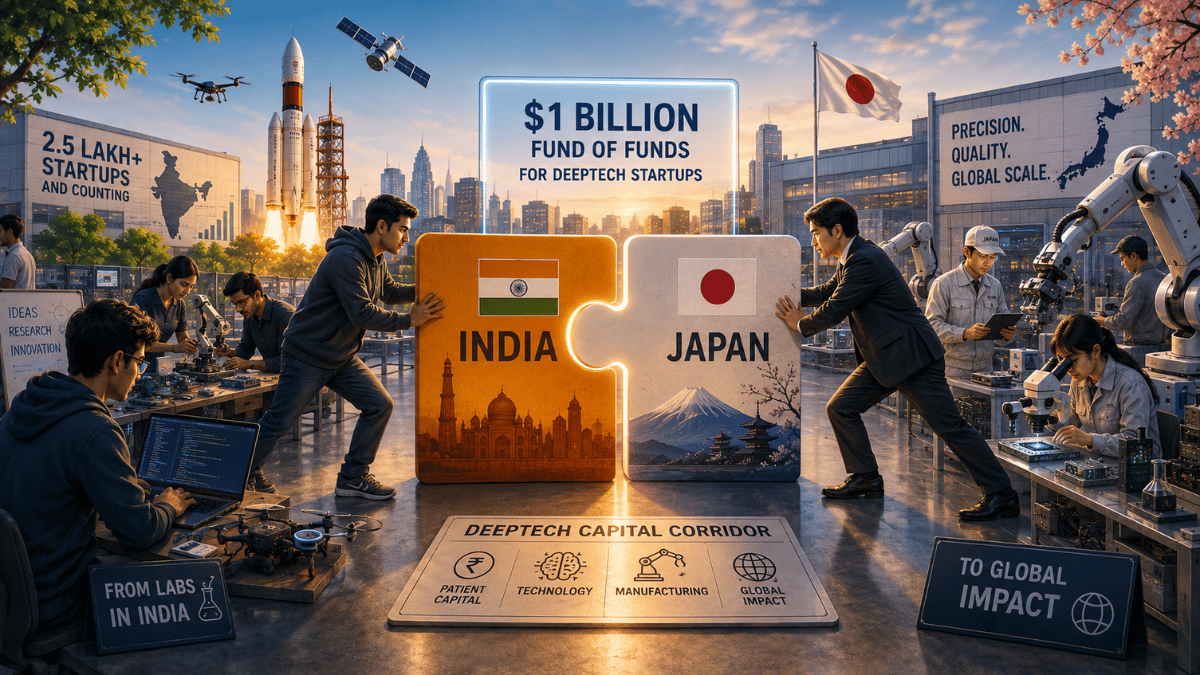




India doesn't exactly have a startup shortage.
Over the last decade, the country has built nearly 2.5 lakh startups, becoming the world's third-largest startup ecosystem. We have founders building everything from fintech apps to drones, robotics, semiconductors and space technology.
But building a startup and building a deeptech company are two very different things.
And that's probably why Commerce and Industry Minister Piyush Goyal was in Tokyo pitching something interesting: deeper India-Japan startup cooperation, a Japan-India Deep-Tech Capital Corridor, and India's proposed second $1 billion Fund of Funds focused on deeptech enterprises.
So why does one of the world's largest startup ecosystems need Japan?
Imagine you're building a SaaS startup. You can develop a product with a small team, put it online, find customers and keep improving it.
Now imagine you're building a semiconductor, industrial robot or aerospace component. You may spend years on R&D, prototypes, testing and certifications before meaningful revenue arrives.
That makes deeptech expensive and slow to build. And it requires something ordinary startups don't always need: patient capital — investors willing to fund technology today and wait years for the business to mature.
That's exactly what Goyal wants Japan to bring into the equation. The proposed Deep-Tech Capital Corridor is aimed at mobilising patient capital for early-stage research, deeptech innovation and commercialisation.
If this were only about raising capital, Indian startups could approach more venture funds.
Japan potentially solves another problem: manufacturing.
India has engineering talent, a huge domestic market and a growing deeptech ecosystem. Japan has decades of experience in precision engineering, advanced manufacturing and producing technology at global quality standards.
Put those together and the partnership starts making sense.
An Indian startup could develop and validate technology here, while Japanese partners could potentially provide manufacturing expertise, capital, technology or access to global supply chains.
So the opportunity isn't simply Japan invests, India builds. It's closer to India innovating, while Japan helps turn that innovation into globally competitive products.
Goyal also highlighted India's proposed second Fund of Funds of around $1 billion, with a focus on deeptech companies, and invited Japanese investors to participate.
A Fund of Funds works differently from a normal VC fund. Instead of the government directly picking a semiconductor or robotics startup, the capital can flow through investment funds, which then invest in companies.
That matters because sectors such as AI, semiconductors, healthcare, space, defence and advanced manufacturing can require significant amounts of capital before reaching commercial scale.
And India and Japan aren't starting from zero.
The India-Japan Pitching Series has already connected 65 Indian startups with around 100 Japanese corporations, resulting in more than 30 business tie-ups. The next step is to make these connections more systematic through startup pitching platforms and a proposed Two-Way Innovation Bridge connecting universities, incubators, investors, R&D centres and laboratories.
That's particularly important for deeptech because many of these businesses don't begin with someone sitting at a laptop.
They begin inside a laboratory.
Getting Japanese capital into Indian deeptech doesn't automatically create successful companies.
A startup may build an excellent prototype but struggle to manufacture it cheaply. Another may manufacture successfully but fail to find enough customers. And a company that succeeds in India may still struggle with certification and distribution overseas.
That's why the partnership has to go beyond funding.
Indian startups need testing facilities, manufacturing expertise, customers and global supply chains alongside capital. Japan, meanwhile, gets access to India's engineering talent, entrepreneurial speed and a huge market where technologies can be tested and deployed at scale.
Both sides have something the other needs.
India's first major startup wave was dominated by internet businesses — e-commerce, fintech, food delivery and SaaS.
The next one could look very different.
If India wants to build globally competitive companies in robotics, semiconductors, space or advanced manufacturing, founders won't just need developers and venture capital. They'll need factories, laboratories, patient capital and global industrial partnerships.
And that's what makes the Japan conversation interesting.
India already has the founders and engineering talent. Japan has capital, technology and decades of manufacturing expertise. The proposed $1 billion fund and Deep-Tech Capital Corridor are attempts to connect the two.
But the real test won't be how many startup pitches happen or how many partnership agreements get signed.
It will be whether an Indian startup can use this combination to move from a laboratory in India to a product manufactured at global standards and sold around the world.
Because India's next unicorn may not need another million app downloads. It may need a Japanese factory floor.
Disclaimer: This content is published for informational and educational purposes only and should not be considered legal, tax, financial, or professional advice. Please consult a qualified professional before making any financial or business decisions. Startup Movers shall not be liable for any loss or damage arising from reliance on this content.

Published Date: 27 Aug 26

April 2025 – In a strategic move bridging sports and wellness entrepreneurship, Indian cricketer Rin...
READ MORE

February 2025 – In a significant leap toward revolutionizing India’s clean energy future, Dreamfly I...
READ MORE

Sending money abroad is usually a fairly routine business transaction. An Indian company pays an ove...
READ MORE
March 2025 –In a move that signals the growing investor appetite for India’s gaming sector, Qila Gam...
READ MORE



© 2026 Startup Movers All rights reserved. | Designed By : The Night Marketer