Confused between Pre-Seed and Seed Funding? Every Big Tree Starts as a Small Seed, understand your Startup Funding journey in a similar way.
Think of a startup like a plant. Pre-seed is the first bit of water. You've just planted the seed. Investors don't expect flowers yet, they just want to see the soil is good, the seed is real, and someone is watering it every day.
While Seed is the second round of water, given once the plant has actually sprouted. Now investors want to see leaves. They want proof the plant is alive and growing on its own, not just standing there.
This is the basic difference between both the terms âPre-Seedâ and âSeedâ Funding. Go through this blog in detail to understand what these funds are and âwhat investors can expect in 2026â with more clarity.
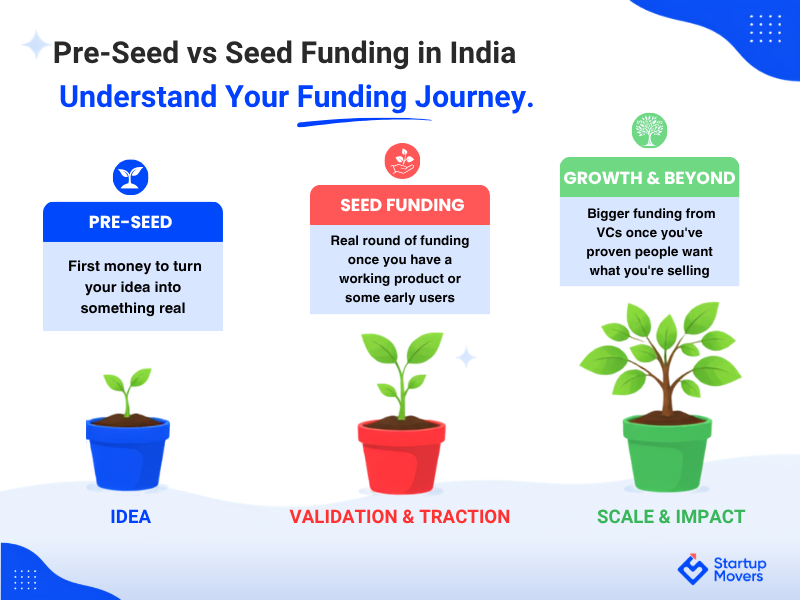
Pre-seed is usually the first money that comes from outside the founders' own pockets. It's not meant to make you rich, it's meant to help you turn an idea into something people can actually use. A working sample of the product, few early users and a first small test run.
In 2025, pre-seed amounts in India sit between ₹2.5 crore and ₹14 crore. Founders mostly spend this on building the product, hiring the first few important people, and trying out simple ways to find customers.
Mostly angel investors (wealthy individuals), groups of angels working together, and small early-stage funds, support this funding.
Here's Something Important: At pre-seed, you don't need to be making money yet. Investors are happy to see other signs instead, like more people using your product each week, free-trial users who start paying, people coming back to use it again, or written letters from companies saying "yes, we'd buy this."
What matters most is whether you deeply understand the problem, have a solid team, and can show early proof that real people care about what you're building.
Letâs imagine, Priya runs a small SaaS tool for local grocery stores. She has no revenue yet, but 40 stores are using her free trial, and 12 have asked to keep using it after the trial ends. That's the kind of early signal pre-seed investors love, even without a single rupee of revenue.
Seed funding comes after pre-seed. By now, you should already have a working product, some paying customers, and real data to back up your pitch.
In 2026, seed rounds in India usually range from ₹5 crore to ₹15 crore. This money helps you build a bigger product team, grow your customer base, and possibly enter new markets.
At this stage, investors want more than growing users. They want:
For SaaS and product-based startups, investors dig into specific numbers: how many customers stay each month (called retention), how many leave (churn), how much it costs to get one customer (CAC), and how much that customer is worth over time (LTV).
Mostly early-stage VC firms, bigger angel groups, and sometimes companies from your own industry who invest strategically.
Basically, the question shifts from "can this idea work?" to "can this idea work again and again, without falling apart?"
Choosing the right fundraising strategy can save months of effort and improve investor conversations.
Talk to Startup Movers for practical guidance before approaching investors.|
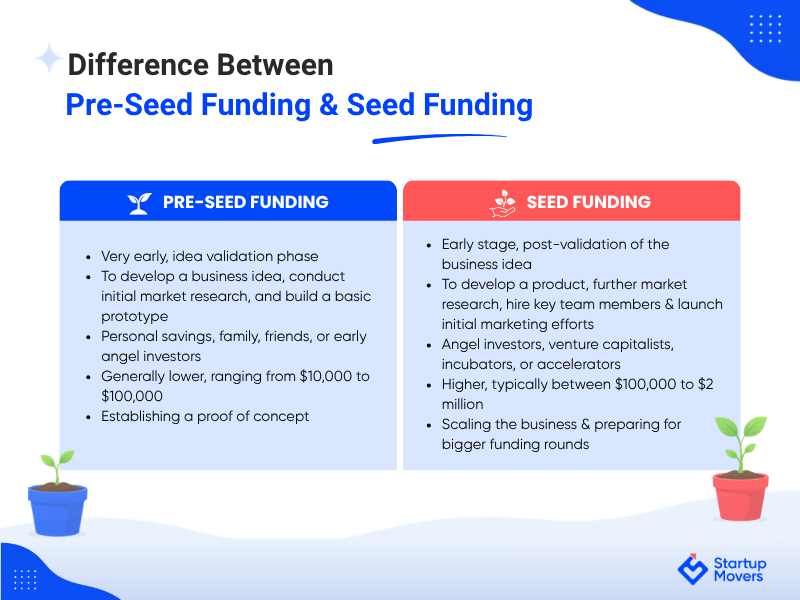
Particulars |
Pre-Seed |
Seed |
|
Stage |
Very early, idea validation phase |
Early stage, post-validation of the business idea |
|
What investors want |
Good team, clear problem, early signs of interest |
Proof: steady revenue, retention, unit economics |
|
Revenue needed? |
Generally lower, ranging from $10,000 to $100,000 |
Higher, typically between $100,000 to $2 million |
|
Who invests |
Angels, angel groups, micro-VCs |
Early-stage VCs, larger angel syndicates, strategic investors |
|
Focus |
Establishing a proof of concept |
Scaling the business & preparing for bigger funding rounds |
|
Main question asked |
"Can this work?" |
"Can this work again and again, efficiently?" |
Early-stage funding is still active in India. In fact, while total tech startup funding across India dropped by around 18% in FY26, early-stage tech startup funding actually went up by 33% compared to FY 2025 [1]. That's good news but it also means investors are being more careful with each cheque they write.
Investors want founders who've lived the problem. Someone who worked in logistics for years, then starts a logistics startup, is more convincing than someone jumping in with no experience.
You don't need to promise a billion-dollar market. You need a clear, believable story: this is the problem, this is who has it, this is how big it could become.
This looks different depending on your business:
Even tiny numbers count, as long as they're growing steadily.
Investors ask: Have you worked together before? Do you cover tech, sales, and industry knowledge between you? Do you have a plan to hire for the gaps?
Skip vague lines like "we'll grow 10x." Instead, say something like: "We'll onboard 20 paying customers, hit ₹15L in yearly revenue, and keep customer loss under 5%." Specific plans build trust.
By seed stage, the checks get stricter.
Investors want to see money coming in every month or quarter, not one lucky spike. They also want to see it isn't all coming from one big customer. Most Indian seed rounds look for ₹10L to ₹50L+ in yearly revenue, growing steadily for at least 2â3 months.
For SaaS businesses, investors check numbers like Net Revenue Retention above 100%, gross margins around 65â75%, and monthly customer loss under 5%. For consumer businesses, they check whether people keep coming back after their first purchase, and whether more customers are arriving through word-of-mouth instead of paid ads.
Investors look at how much it costs to win one customer (CAC), how much that customer is worth over time (LTV, ideally at least 3 times the CAC), and how long it takes to earn that cost back (usually 6-12 months for B2B).
You should be able to explain exactly who your customer is, how you're reaching them, what your sales process looks like, and what you're still testing.
Even simple tracking in a spreadsheet is fine, investors just want to see you're watching your numbers and changing course based on what they tell you.
A year later, Priya's SaaS tool is now used by 60 paying grocery stores. She noticed enterprise clients take longer to close but pay twice as much over time, so she shifted 40% of her team's focus toward larger stores. That's exactly the kind of data-driven decision seed investors want to see.
Founders who combine early traction with strong legal and financial compliance stand out to investors.
Startup Movers helps startups prepare for successful fundraising.India's funding story in 2026 isn't about a slowdown, it's about investors being more careful with their money. Investors are writing smaller, more thoughtful cheques, and paying close attention to how efficiently a startup uses its money.
The average deal size in Q1 2026 was around $3.3M, up 17% from the year before, a sign investors are being more cautious even as they keep investing.
For founders, this means smaller rounds than the 2021â2022 boom years, a much bigger focus on real numbers, and more pressure to show a path toward eventually turning a profit. Startups working in AI and enterprise SaaS got a bigger share of VC money in Q1âQ2 2026, along with slightly better valuations, but also higher expectations to match.
Steps to prepare Pre-seed Funding Checklist:
Steps to prepare Seed Funding Checklist:
The most common ways founders lose investor trust:
Fixing these issues before investor due diligence saves both time and credibility.
Get your startup fundraising-ready with Startup Movers' expert support.Disclaimer: This content is published for informational and educational purposes only and should not be considered legal, tax, financial, or professional advice. Please consult a qualified professional before making any financial or business decisions. Startup Movers shall not be liable for any loss or damage arising from reliance on this content.
Published Date: 10 Jul 26







© 2026 Startup Movers All rights reserved. | Designed By : The Night Marketer




Leave a Comment
Comments
No comments yet.
RECENT ARTICLES
Documents Required for Private Limited Company: The Complete 2026 Checklist
E-Commerce Compliance in India: GST, TDS & TCS
Understand the Different Types of Business Registration in India
Startup India Scheme: Top Government Schemes and Financial Incentives for Entrepreneurs
EPFO Wage Ceiling Raised from ₹15,000 to ₹25,000: Will Your PF Deduction and Take-Home Salary Change?
Depreciation Under AS 10 and Intangible Assets Under AS 26
GST Compliance for Online Food Sellers: Your Comprehensive Guide
MCA Extended CCFS Deadline to 15 September