Each registered company is assigned with a unique number commonly known as Corporate Identification Number (CIN). Corporate Identification Number or Company Identification Number helps in identifying companies in detail and it is mandatory for all companies to mention their CIN on the official documents including letterhead once the company gets incorporated.
But what if CIN is not mentioned on these documents? In this blog, we will discuss in detail what is a CIN number, Corporate Identification Number breakdown, use of CIN, penalty for non-compliance, change in CIN, and many more.
A CIN or Corporate Identification Number is a 21 digit alpha numeric number assigned to companies incorporated within the country by the Registrar of Companies. This CIN is provided to all types of companies including the Private Limited Companies, One Person Companies, State Government Companies, Non-profit Organizations, Section 8 Companies, Nidhi Companies, etc. It is important to note that for LLPs, corporate identification number is not issued while for LLPs one LLPIN is issued. A Corporate Identification Number (CIN) includes 6 sections with each different purpose. Let’s understand the detailed breakdown of CIN.
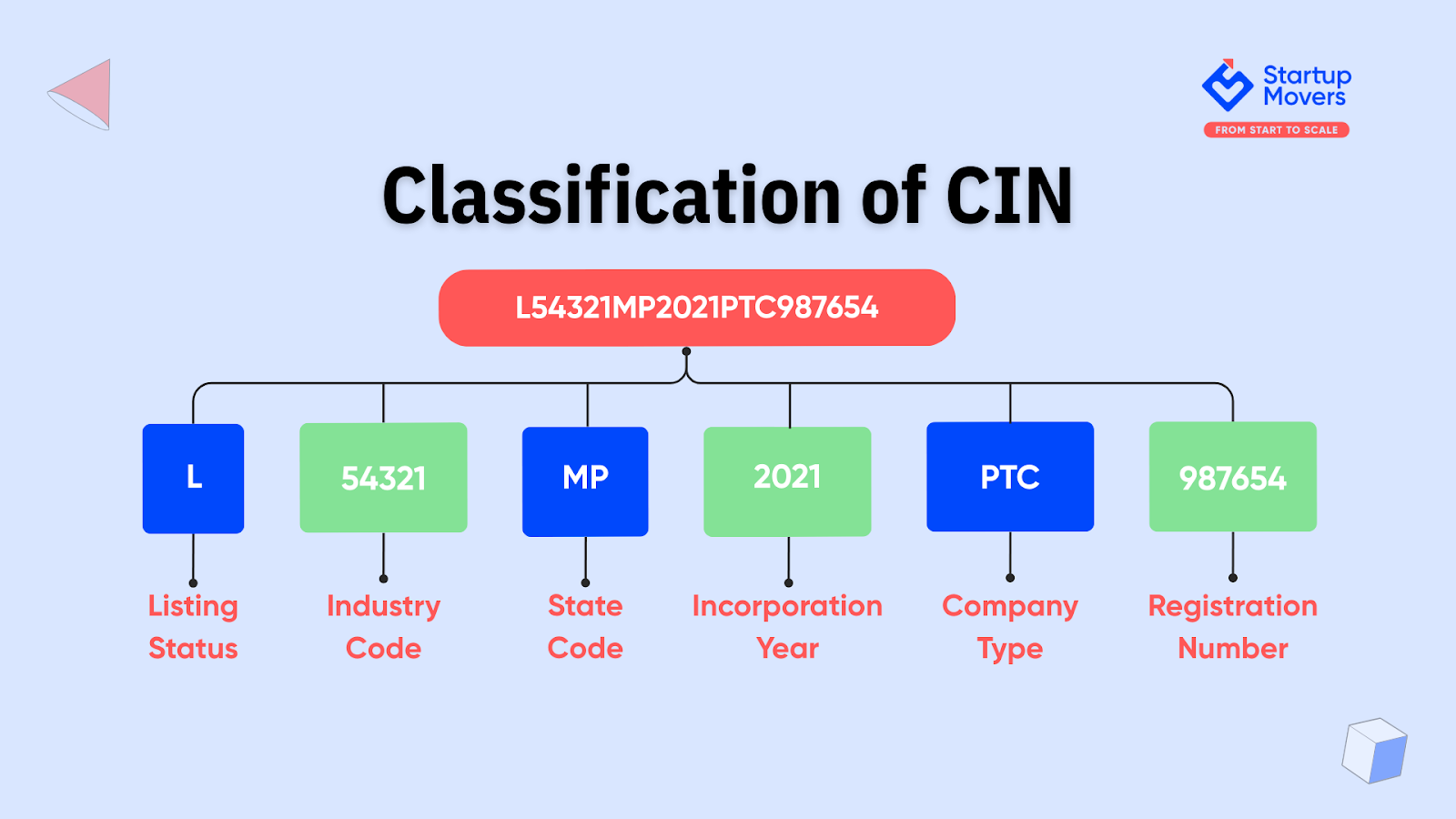
A Corporate Identification Number includes 6 major sections and they are as follows:
Section 1: Listing Status: The first section includes one single place represented as “L”or “U”. Here “L” represents the company that is listed while “U” represents the company that is unlisted.
Section 2: Industry Code: The next 5 digits of CIN represents the industry code of the company. This classification is based on the nature of business activity by the Ministry of Corporate Affairs.
Section 3: State Code: The Next 2 alphabets represent the state in which the company is registered.
Section 4: Incorporation Year: The next four digits represent the year of company incorporation.
Section 5: Company Type: The next three letters represent the type of company either a PTC (Private Limited Company), PLC (Public Limited Company), LLP (Limited Liability Partnership), etc.
Section 6: Registration Number: The last six digits of CIN denotes the registration number of the company provided by the Registrar of Companies.
For Example: Let’s assume an imaginary CIN number for better clarity —
L54321MP2021PTC987654
Common Confusion: People get confused with the abbreviation used for company structure. It is advised to check abbreviation & business structure clearly to avoid confusion.
|
Company Type |
Full Form of Company Types under CIN |
|
FLC |
Financial Lease Company as Public Limited |
|
FTC |
Subsidiary of a Foreign Company as Private Limited Company |
|
GAP |
General Association Public |
|
GAT |
General Association Private |
|
GOI |
Companies owned by the Government of India |
|
NPL |
Not-for-Profit License Company (Section 8 Company) |
|
OPC |
|
|
PLC |
Public Limited Company |
|
PTC |
|
|
SGC |
Companies owned by State Government |
|
ULL |
Public Limited Company with Unlimited Liability |
|
ULT |
Private Limited Company with Unlimited Liability |
Planning to register a company and obtain your CIN? Our Company Incorporation Services handle name approval, MCA filings and incorporation from start to finish.
Corporate Identification Number commonly known as CIN Number is used on multiple documents prepared by the company. Following is the list of documents where Corporate Identification Number is used:
It is mandatory for each registered company to indicate its Corporate Identification Number on business letters, billheads, notices, etc as per section 12(3)(c) of Companies Act, 2013. In case if the company fails to do so, there will be a penalty of ₹1000/- per day till the default continues as per section 12(8) of Companies Act, 2013. However, this penalty is limited up to ₹1,00,000/-. Also, it is important to note this penalty will apply to the company and every officer in default. It is advised to stay compliant to avoid heavy penalties and legal consequences.
Corporate Identification Number or CIN Number is a crucial part for any company registered with MCA. CIN is provided to each registered company providing it a unique identity but this CIN may need to be changed in case of change within the company. These changes can be as follow:
CIN Number or Corporate Identification Number is a 21 digit alpha-numeric number assigned to each registered company with MCA. This number includes listing status, industry code, state status, incorporation year, company structure and registration number. It is important to stay compliant with CIN to avoid heavy penalties and legal consequences. CIN number needs to be updated with MCA in case of change in state or location, industry sector, listing status or business structure. In case of non-complaint ₹1,000/- per day penalty is levied on the company which can go up to ₹1 lakh. It is advised to keep your CIN number active so that no legal action would be taken against the company. To avoid the hassle of managing CIN activation, consult with an expert in this field.
Need help registering your company or managing incorporation-related filings? Connect with Startup Movers and let our experts handle the process smoothly.
Disclaimer: This content is published for informational and educational purposes only and should not be considered legal, tax, financial, or professional advice. Please consult a qualified professional before making any financial or business decisions. Startup Movers shall not be liable for any loss or damage arising from reliance on this content.

Published Date: 16 Jan 26







© 2026 Startup Movers All rights reserved. | Designed By : The Night Marketer




Leave a Comment
Comments
No comments yet.
RECENT ARTICLES
57th GST Council Meeting 2026: Key Decisions, New Rules & Changes
How to File EDF for Service Exports in India? Step-by-Step Guide (2026)
EDF Filing for Service Exporters from 1 October 2026: Complete Guide
GST Portal Introduces Multi-State GST Registration: One Master TRN for Multiple States
CBDT Extends ITR and Tax Audit Due Dates for AY 2026-27
Documents Required for Private Limited Company: The Complete 2026 Checklist
E-Commerce Compliance in India: GST, TDS & TCS
Understand the Different Types of Business Registration in India