Business
Company Incorporation Stamp Duty Calculator
Check stamp duty in your State and incorporate hassle-free.
Calculate




UPI has trained us to expect one thing from digital payments, scan, pay and move on without thinking about transaction charges.
Whether you’re splitting a ₹2,000 dinner bill with a friend or scanning a QR code at your neighbourhood store, UPI has largely felt free. And that simplicity has played a big role in making it India’s default digital payment system.
But from October 15, 2026, a part of that model is changing.
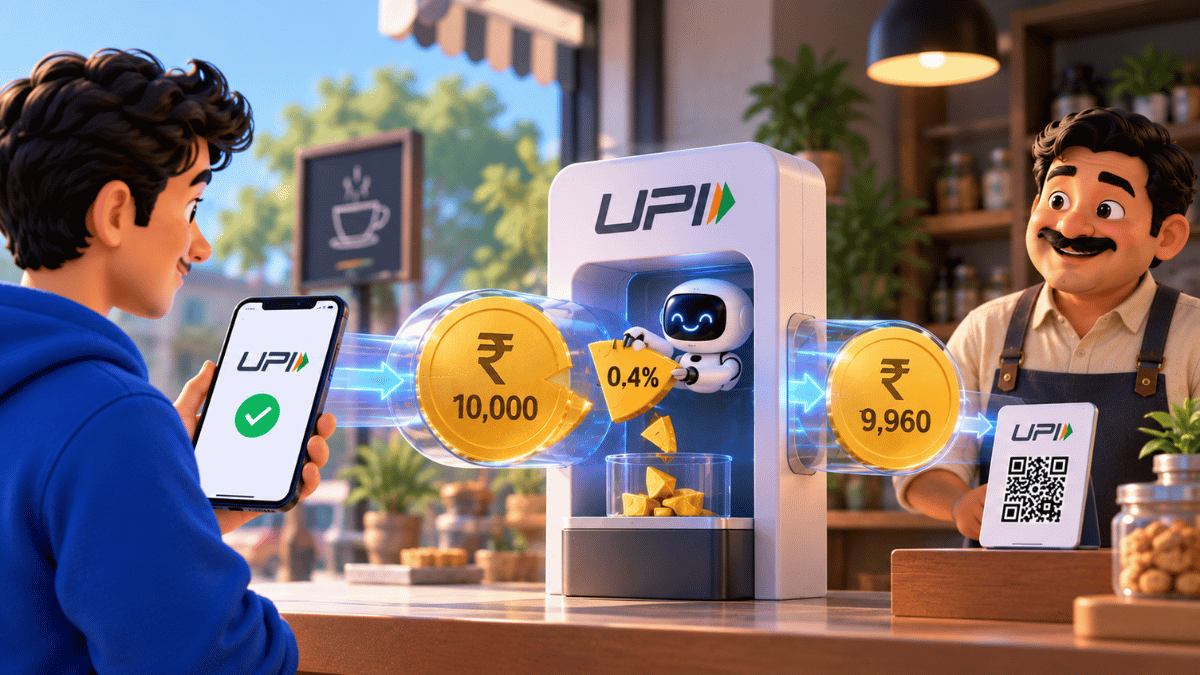
A revised Merchant Discount Rate (MDR) framework will introduce charges on select UPI merchant transactions above ₹2,000. For applicable Person-to-Merchant (P2M) transactions, the MDR will be 0.4%, capped at ₹300 per transaction.
Now that sounds like UPI is becoming paid. But there’s an important distinction.
No.
The MDR is a merchant-side fee, not an additional charge that the consumer is supposed to pay. If an eligible merchant receives a ₹10,000 UPI payment, the applicable 0.4% MDR would work out to ₹40.
At ₹50,000, it would be ₹200. And at ₹75,000, the charge reaches the ₹300 cap. Beyond that amount, the standard MDR would remain capped at ₹300 per transaction.
The government has also clarified that MDR isn't a tax or revenue collected by the government or NPCI. Instead, it is distributed among participants involved in processing the payment, including banks and payment service providers.
This is where the framework becomes more interesting.
Person-to-Person (P2P) transactions remain free, irrespective of the amount. So transferring ₹5,000 to your friend or ₹50,000 to a family member doesn't fall under this MDR framework.
Merchant transactions of ₹2,000 or less also remain outside MDR. And qualifying small merchants receiving up to ₹1 lakh per month through UPI QR payments under the P2PM framework will continue to benefit from zero MDR.
That means your everyday QR-code payment at a small neighbourhood shop may look exactly the same after October 15.
In fact, the government says roughly 96% of UPI P2M transactions will remain unaffected by the revised MDR structure.
There’s another layer.
For specified merchant categories such as railways, telecom services, insurance and fuel, UPI transactions above ₹2,000 will attract a flat ₹5 MDR per transaction, rather than the regular 0.4% structure.
So the framework isn't simply “anything above ₹2,000 gets charged 0.4%.” The amount depends on the type of transaction and merchant involved.
Because a payment can be free for you without being free to operate.
Every UPI transaction runs through a much larger infrastructure involving banks, payment service providers, technology systems, cybersecurity, fraud prevention and settlement infrastructure.
As UPI expands, maintaining and upgrading this ecosystem costs money. The revised framework attempts to create a revenue stream from select higher-value merchant transactions while keeping consumers, small merchants and the vast majority of everyday UPI transactions outside the MDR net.
And perhaps that's the bigger story here.
For years, India’s UPI challenge was about getting more people to use digital payments. Now that UPI has reached massive scale, another question is becoming increasingly important:
How do you keep the world’s biggest real-time payment ecosystem sustainable without making everyday payments expensive?
From October 15, a 0.4% charge on a relatively small slice of UPI transactions is one attempt at answering that question.
Disclaimer: This content is published for informational and educational purposes only and should not be considered legal, tax, financial, or professional advice. Please consult a qualified professional before making any financial or business decisions. Startup Movers shall not be liable for any loss or damage arising from reliance on this content.

Published Date: 16 Sep 26
February 2026 - The Supreme Court’s Tiger Global ruling is being closely watched across India’s star...
READ MORE
AI has become one of the most crowded investment themes in the world. Investors are pouring billions...
READ MORE

February 2025 – In a significant leap toward revolutionizing India’s clean energy future, Dreamfly I...
READ MORE

December 2025 - Recently, business accounting startup Vyapar has announced the acquisition of Suvit....
READ MORE



© 2026 Startup Movers All rights reserved. | Designed By : The Night Marketer