
Business
Company Incorporation Stamp Duty Calculator
Check stamp duty in your State and incorporate hassle-free.
Calculate
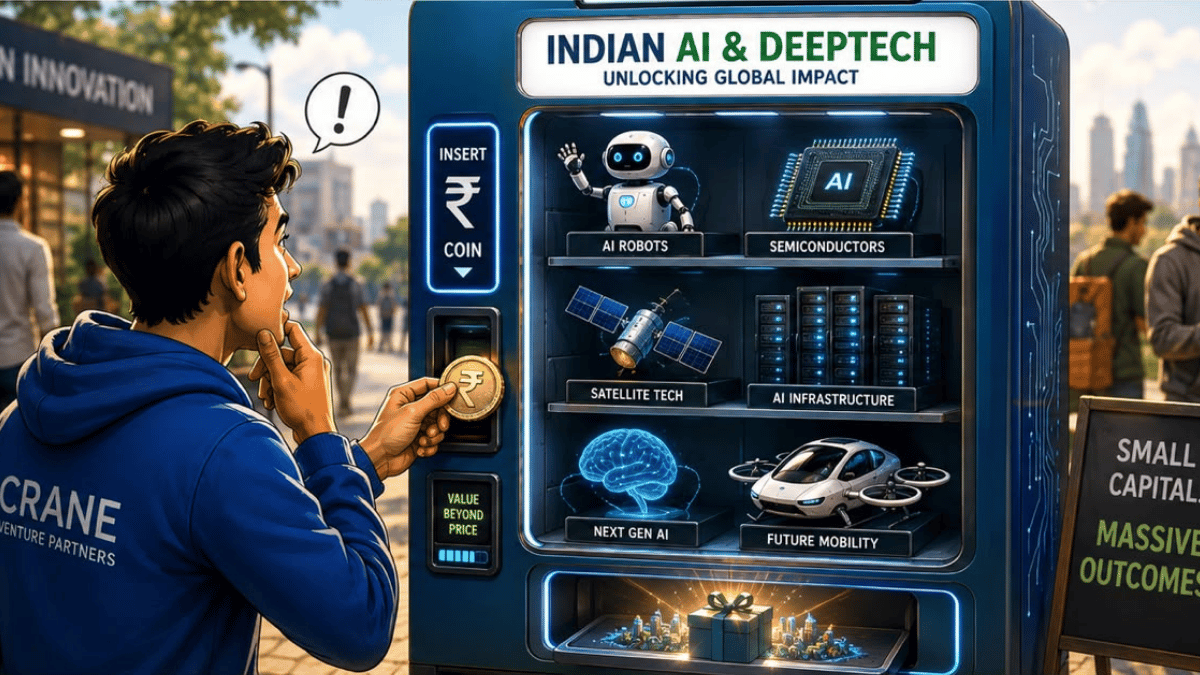




AI has become one of the most crowded investment themes in the world.
Investors are pouring billions into companies building AI models, chips and infrastructure. So, when a global venture capital firm says Indian AI and deeptech are among the “most mispriced” asset classes in the world, it sounds a little surprising.
But Crane Venture Partners isn't just making a prediction from the sidelines. The firm has raised a $150 million APAC fund, and expects around 75–80% of that capital to be deployed in India. It has already made around 9–10 investments and plans to build a portfolio of roughly 30–35 companies.
So what does Crane see that other investors might be missing?
For years, India's startup advantage was fairly straightforward. Build something that already works elsewhere, sell it to a huge domestic market and operate at a lower cost.
But the next generation of startups could look very different.
Crane believes Indian founders are increasingly building AI, deeptech, semiconductor, robotics and infrastructure companies for global markets, rather than simply adapting existing business models for India. And that matters because difficult technology can create a very different kind of competitive advantage.
Imagine two startups trying to solve a $1 billion problem.
One needs hundreds of millions of dollars to build the technology, hire talent and compete for computing resources. The other can achieve a similar technical breakthrough with a much smaller team and a lower cost base.
The second company doesn't necessarily need to become bigger to be more attractive.
It simply needs to create a large outcome from a smaller amount of capital.
That's essentially the bet Crane is making on India.
Crane's APAC fund closed at $150 million in September 2025. While the fund covers India, Singapore and Australia, India is expected to receive the majority of the capital — around 75–80%, or roughly $100–120 million.
The firm typically writes initial cheques of around $2–3 million, although investments can range from about $500,000 at the earliest stages to as much as $6 million.
That tells you something about the strategy.
Crane isn't waiting for these companies to become billion-dollar businesses before investing. It wants to get in when the technology is still being built and valuations are relatively small.
And it isn't limiting itself to startups that simply add an AI feature to an existing product.
Around 35–40% of its investments so far are in hard deeptech, while AI remains another major focus. The firm is also looking at areas such as semiconductors, robotics, infrastructure and security.
Think about what a VC is actually buying.
It isn't buying today's revenue.
It's buying a small piece of a company that could become much larger in the future.
So if you invest $3 million in a company valued at $15 million and that company eventually becomes worth $1 billion, the return can be enormous.
But if you make the same investment after the company has already become highly valued, the potential upside changes.
That's where India becomes interesting for Crane.
The firm believes Indian deeptech and AI startups can potentially build global businesses while requiring less capital than comparable companies in markets such as the US.
So the opportunity isn't simply that Indian startups are cheap.
It's that they may be able to turn a relatively small amount of capital into a disproportionately large outcome.
Building deeptech isn't like building another consumer app.
A consumer startup can launch a product, acquire users and make changes based on what customers want. A semiconductor or robotics company might spend years developing the technology before the business reaches meaningful commercial scale.
That creates a funding problem.
Crane believes seed and Series A capital is becoming more available for Indian deeptech, but later-stage funding could still become a bottleneck.
And this is important.
Getting the first $2 million isn't necessarily the hardest part.
The real challenge could be raising the next $20 million, $50 million or $100 million when the company is ready to manufacture, scale internationally or compete with much larger global players.
In other words, India may have enough capital to start the deeptech journey.
The question is whether it has enough capital to finish it.
The early numbers are encouraging.
Indian AI startups attracted $459 million across 82 deals between January and May 2026, a 62% increase from the same period a year earlier, according to Venture Intelligence data reported by Moneycontrol.
But there's a catch.
Growth-stage funding has remained much weaker.
That means more investors are willing to fund the beginning of the story, but fewer are willing to finance the companies once they need significantly larger cheques to scale.
And that's exactly where Crane's thesis will be tested.
If Indian AI and deeptech companies can cross that funding gap and become global businesses, today's relatively small investments could look very cheap in hindsight.
If they can't, then being “mispriced” may simply mean investors underestimated the risks.
We don't know yet.
But Crane is making a fairly specific bet.
It isn't saying every Indian AI startup will succeed. It is betting that India has a combination of technical talent, lower operating costs, ambitious founders and an increasingly mature startup ecosystem that could produce globally relevant technology companies without requiring Silicon Valley-sized amounts of capital.
And that's what makes this story more interesting than another VC saying “India has huge potential.”
Crane has already committed capital.
It expects the majority of its $150 million APAC fund to go into India and is actively building a portfolio around AI and deeptech.
So now the market gets to test the thesis.
Can Indian founders build billion-dollar technology companies without billion-dollar funding rounds?
If the answer is yes, then perhaps Indian AI isn't underpriced because it is cheap.
It is underpriced because the market hasn't fully realised how much can be built with relatively little capital.
Disclaimer: This content is published for informational and educational purposes only and should not be considered legal, tax, financial, or professional advice. Please consult a qualified professional before making any financial or business decisions. Startup Movers shall not be liable for any loss or damage arising from reliance on this content.

Published Date: 24 Aug 26

February 2026 - Gully Labs, a culture-driven sneaker brand co-founded by Arjun Singh and Animesh Mis...
READ MORE

September 2026 — Bengaluru-based fabric care startup Iztri has raised ₹10 crore (approximately $1.1...
READ MORE

UPI has trained us to expect one thing from digital payments, scan, pay and move on without thinking...
READ MORE

You might have seen Yulu's electric bikes zipping around Indian cities. They are small, quiet and in...
READ MORE



© 2026 Startup Movers All rights reserved. | Designed By : The Night Marketer